Search
Items tagged with: QueenElizabeth

#PrincePhilip #DukeOfEdinburgh #UK #QueenElizabethThe Queen has lost her protector, but everything they built together lives on
In marrying for love, the Queen pulled off a rebellious feat for a monarch – and forged a terrific team that stood the test of time
Allison Pearson
9 April 2021 • 7:18pm
Allison Pearson
The Queen flashes a smile at Prince Philip, during the Trooping the Colour parade in 2009
If you surprised yourself by shedding a tear – as millions of us did – when you heard that Prince Philip was gone, no small part of that sadness will have been for his widow, our Queen and his beloved wife.
In 62 days, Her Majesty would have been able to send the Duke of Edinburgh a telegram for his 100th birthday. That would have amused them both. (They never stopped laughing together.) If he could possibly have hung on to give her that satisfaction, you just know that he would. For that was his job, always and until his final breath. He was her champion, “my strength and stay all these years,” the Queen called him on their Golden Wedding anniversary. Who will be there for her now he is gone?
Elizabeth and Philip, Philip and Elizabeth, their names and their destinies braided tightly together since their marriage 73 years ago in Westminster Abbey. The bride on that freezing November day appeared to be almost levitating with happiness, and no wonder.
The ridiculously handsome groom was an impecunious Greek prince (mainly Danish actually) out of a Hans Christian Andersen fairytale. Not for her some three-chinned Earl. Mrs Philip Mountbatten (as she would never be known) had pulled off one of the most daring feats ever observed in a constitutional monarchy. She had married for love.
Philip and Elizabeth, they must have thought they had 20 years to themselves, when they could raise a family and he could become Admiral on merit, before her father, King George, died and the door on the cage of Royal duty clanged shut. It was not to be.
Just four and a quarter years later, they were back in the Abbey for the Coronation and that restless, questing, charismatic man was kneeling before her, making a solemn promise: “I Philip, Duke of Edinburgh, do become your liegeman of life and limb and of earthly worship; and faith and truth I will bear unto you, to live and die against all manner of folks. So help me God.”
That was always the deal. To be her eyes and her ears, to speak truth unto Majesty. To not lie to her, nor fawn or flatter as others would. The Duke was the only one who dared shout at the Queen (she was known to yell back, particularly when he criticised her driving). Hers was the loneliest job in the world. Because she was a human to him before she plighted her troth to God, he made it less lonely.
All marriages are complicated. Philip and Elizabeth’s, it’s fair to say, was on another level. On Coronation Day, the flesh and blood woman he had taken for his wife was suddenly his anointed sovereign. A report in The Telegraph captured the metaphysical moment when the two roles – of husband and subject – became one: “She took his hand in hers before he drew back to touch the Crown and to kiss her on the left cheek.”
An impatient dynamo who passed out as best all-round cadet in his class at Dartmouth, Lieutenant Philip Mountbatten was destined to be a leader of men. From then on, he would follow a woman. It was a huge ask for an Alpha male of his generation. But if Elizabeth ruled the country, Philip’s word was law at home, even when she disagreed with him (about Prince Charles’s schooling to take one example).
So indispensable did he become to our national life that we now feel that, if there had never been a Duke of Edinburgh, it would have been necessary to invent him. It’s very easy to forget that, when he first came on the scene, Philip was considered a risk by a xenophobic Establishment. “Moustache types bristling away about ‘ghastly foreign fellows’, especially after the war,” as one courtier recalled.
But Lilibet loved him from the first time she saw him, when she was just 13 years old, and refused to consider more suitable candidates. You could say that he was her one act of rebellion, she his one act of conformity.
The Queen and Prince Philip in 2012
The Queen and Prince Philip in 2012 Credit: WireImage
Such different characters, they made a terrific team. As Sir John Colville, private secretary to Princess Elizabeth before she married, noted, “The Queen was frightfully good at knowing when to say ‘No’, though not so good at saying ‘Yes’. Philip on the other hand is good at ‘Yes’. Not the sort of yes-man who agrees with everyone else, but the sort of yes-man who will take a risk.” Today, the monarchy retains much of its pomp, but it had shed a lot of its pomposity thanks to a modernising Duke’s influence over his more traditionalist wife.
They were never openly romantic. Asked once to sign a copy of a mushy book about the Royal couple called Manifest Destiny, Philip crossed out the title and wrote “Manifest Bunkum”. Bunkum was a favourite word, so was travesty.
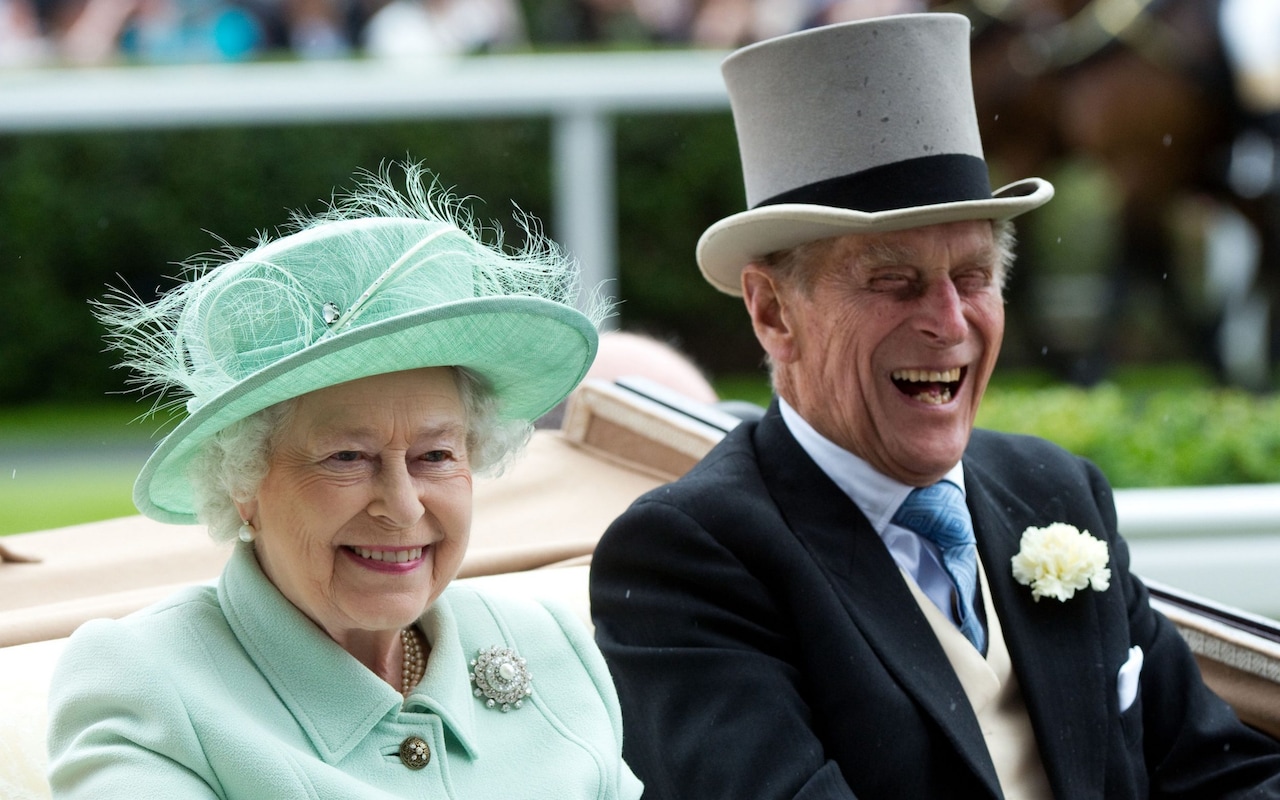
If they were not given to public displays of affection, the couple were bound together by the invaluable adhesive of humour. One of my favourite photographs shows the Queen, her head back and roaring with laughter in front of a Guardsman, his busby sunk low over his eyes. It was Philip, he was teasing her, and her whole face lit up as it had on that freezing November day seventy year before.
Elizabeth and Philip, like any long union, theirs had its secrets. In the late-Fifties, the Duke went on a voyage of self-discovery, leaving his wife at home for four months with the two children. For the prurient, the ten-year gap between the births of Charles and Anne and those of Andrew and Edward – two separate families almost – speaks of a possible drifting apart and eventual reconciliation. None of that matters today.
All the rumours and the gossip fall away and what remains is an enormous sense of gratitude for a magnificent marriage, a monument to patient and tender longevity. After seven often turbulent decades, the Queen and her handsome Prince were a sterling example of the unfashionable virtue of perseverance, of sticking to your vows.
It’s already been such a tough year for the Queen. A dark cloud of suspicion removed Prince Andrew from public life, then came the Duke and Duchess of Sussex with their petulant, cruelly-timed allegations of racism and insensitive treatment when Harry’s grandfather was ill. Throughout lockdown, Her Majesty has tried to keep the nations’ spirits up with stirring speeches (“We’ll meet again”) and Zoom calls. One consolation must have been that husband and wife were isolating together at Windsor, without the call of multiple engagements, ending married life as they began it all those years ago.
Prince Philip’s oldest friend, from his Navy days, recalled that “the Queen always came before everything else for him, how determined he was that everything he did should be for the benefit of his wife, both as a person and as Her Majesty”. Of all the many services the Duke performed for his country, that was the greatest. While he lived, we could take the monarch’s stability and contentment utterly for granted.
Now, at the age of 94, the Queen faces the future without her liegeman of life and limb, of faith and truth. The nation’s heart goes out to her. Her loss is our loss. When she grieves, we grieve.
Her family, particularly her heirs, Prince Charles, and Prince William, who is devoted to his grandmother, will rally round, but the Windsors, who have a tendency to keep their distance, need to draw much closer. Princess Anne, most like her father of all the children, will be a huge consolation and support to her mother.
Today, as we mourn a great and irreplaceable national character, we may half-fear that this is but a dress rehearsal for the sorrow we will feel when we lose our Queen. Not yet, please, not that, not yet. Her champion and protector is gone, but everything they built together lives on.
How blessed we were, Elizabeth and Philip.
https://www.telegraph.co.uk/royal-family/2021/04/09/queen-has-lost-protector-everything-built-together-lives/