From the Wile E. Coyote department of the arachnid world.
The ballista spider resides on trees occupied by the aggressive and territorial green tree ant Oecophylla smaragdina, spending the day in webs hidden beneath the underside of leaves. After nightfall, it drops down some 50cm to a leaf, a branch or the forest floor and creates an anchor point using a silk line.It then spends hours creating a cone-shape "scaffold" of dozens of tension lines, around which it finally wraps a thinner type of silk before retreating upwards. Within moments, scientists found green ants approached the trap and bit it - causing the snare to spring and the prey to be launched into the spider's web at "extreme" acceleration.
The scientists found that these green ants were the only prey captured by the spider, even when they released other nocturnal ants near the trap. They suspect the spider adds pheromones to the trap to lure and anger the green ants alone.
That is unprecedented, Narendra said. "This seems to be the only case where a spider's web is designed to catch a single prey species, and where the mechanism is triggered by the prey rather than by the predator."
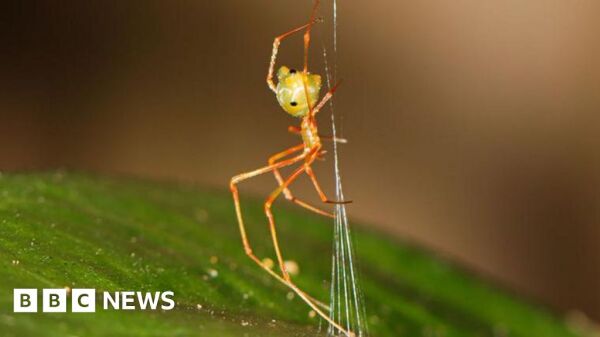
Spider which uses spring trap to capture prey discovered in Australia
Researchers say their hunting method - which allows them to prey on dangerous ants - is unprecedented.Maia Davies (BBC News)
Greg A. Woods likes this.
N. E. Felibata II reshared this.