Cars and bicycles each have fundamentally different and often incompatible requirements w.r.t. the "paths" they need to travel on and their influence on the environment immediately around them.
They often travel at radically different speeds.
They have radically different capabilities w.r.t. protecting their users.
The academic and practical training of engineers and administrative staff in transportation and road authorities in Germany is currently undergoing massive change, perhaps very rapidly.
Katja Diehl is a well-known German mobility expert, author, and activist. [1, 2]
The Transformation in Education
New Focus Professorships: Many universities and universities of applied sciences are increasingly establishing chairs in "Cycling," "Sustainable Mobility," or "Intermodal Transport Planning" to shift the focus away from solely highway and road construction.
Content of the Transportation Transformation:
Modern curricula now increasingly include the equitable allocation of road space, pedestrian and cycling concepts, and the expansion of public transportation.
Katja Diehl's Role:
As a prominent voice (among other things, with her book Autokorrektur) and through her platform She Drives Mobility, she exerts a strong influence on these debates. She regularly demands that the planning of living spaces and
... show more
The academic and practical training of engineers and administrative staff in transportation and road authorities in Germany is currently undergoing massive change, perhaps very rapidly.
Katja Diehl is a well-known German mobility expert, author, and activist. [1, 2]
The Transformation in Education
New Focus Professorships: Many universities and universities of applied sciences are increasingly establishing chairs in "Cycling," "Sustainable Mobility," or "Intermodal Transport Planning" to shift the focus away from solely highway and road construction.
Content of the Transportation Transformation:
Modern curricula now increasingly include the equitable allocation of road space, pedestrian and cycling concepts, and the expansion of public transportation.
Katja Diehl's Role:
As a prominent voice (among other things, with her book Autokorrektur) and through her platform She Drives Mobility, she exerts a strong influence on these debates. She regularly demands that the planning of living spaces and roads must consider the needs of all people—not just those of car traffic. [4, 5, 6, 7]
It is possible to find out at which specific universities the new professorships for cycling and sustainable mobility have been created.
There are 5 new professorships.
Four years for a diploma, and then into a position. Roads are planned, but… concrete is what's being built. In people's minds. In some places. In others. The arguments have been exchanged. It's a distribution or allocation problem; it will be an optimized matrix, elsewhere work in progress ;)…
KATJA DIEHL!
…a matrix adapted to local circumstances and individually optimized for the local traffic area. That's the training. So there are variations. Strict Brutalo through traffic for cars will remain for a while longer, ..
But something has improved over the last years, hasn't it?
Is that an isolated case? I cycle 12 knots on a cycle highway, along the stream, into the city. The cars are almost always 100 meters away from me. There's terrain in between. It's a matter of luck, no one disputes that.
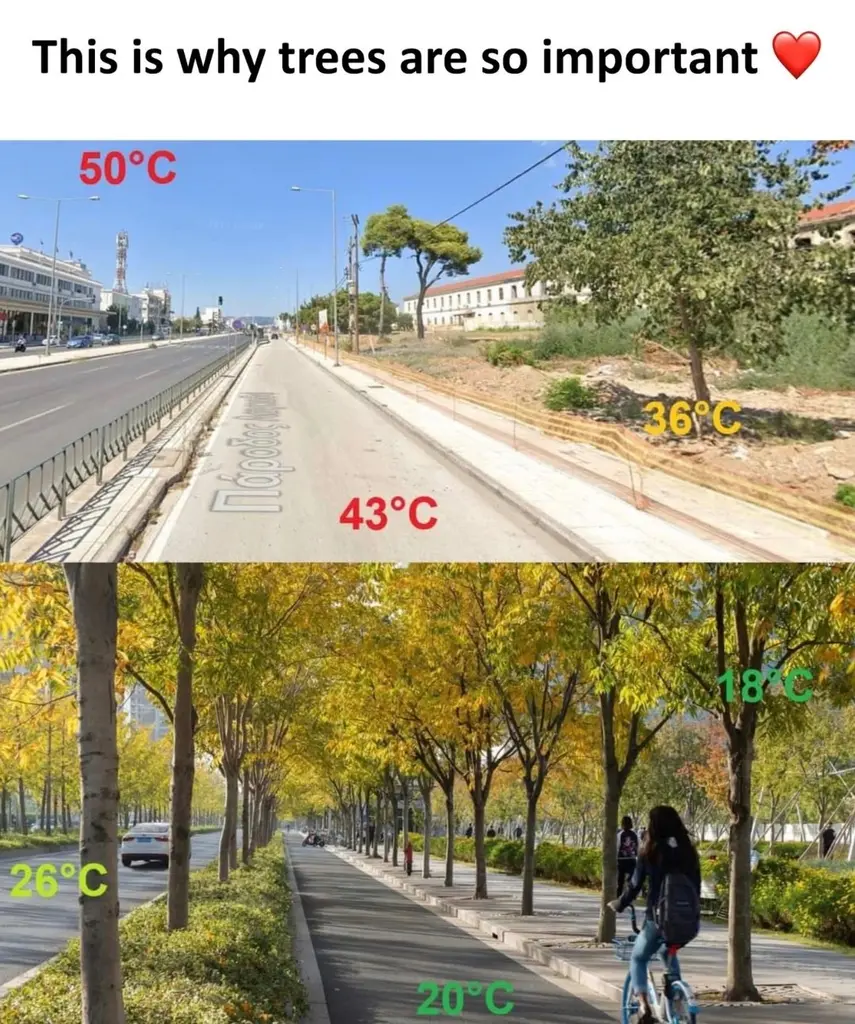
There's a city where I would never ride a bike again because of the SMOG. Anyway, new topic. But here's #Trees, and cool freshness... not a factor? Doubtful, everyone knows that, no one disputes it.
What has changed:
There are budgets as always, but one orthe other, more and more, are concerned about new masses of bikers.
There are intercity bike paths that untangle the congestion. The current situation is:
shortly after the start of a shift in thinking in the planning offices.
The topic is heating up. So, my first attempt, chaos! 😁…
cars and bicycles each have fundamentally different and often incompatible requirements w.r.t. the “paths” they need to travel on and their influence on the environment immediately around them.
Wrong. The starting and ending points of daily commutes are usually predetermined, and the roads connecting them are almost always the shortest and best-maintained routes between those points.
They often travel at radically different speeds.
Misleading. Motor vehicles, too, often travel at radically different speeds. In quite a few motor vehicles, the speed is technically limited. Cyclists frequently exceed these speeds, sometimes without much effort. The speed range of cyclists and motorists mostly overlap. Speeds of pedestrians and cyclists, on the other hand, are radically different. 4-6 km/h vs. 6-60 km/h and more. That's more than an order of magnitude.
They have radically different capabilities w.r.t. protecting their users.
Wrong. Motorcyclists don’t have a car bo
... show more
cars and bicycles each have fundamentally different and often incompatible requirements w.r.t. the “paths” they need to travel on and their influence on the environment immediately around them.
Wrong. The starting and ending points of daily commutes are usually predetermined, and the roads connecting them are almost always the shortest and best-maintained routes between those points.
They often travel at radically different speeds.
Misleading. Motor vehicles, too, often travel at radically different speeds. In quite a few motor vehicles, the speed is technically limited. Cyclists frequently exceed these speeds, sometimes without much effort. The speed range of cyclists and motorists mostly overlap. Speeds of pedestrians and cyclists, on the other hand, are radically different. 4-6 km/h vs. 6-60 km/h and more. That's more than an order of magnitude.
They have radically different capabilities w.r.t. protecting their users.
Wrong. Motorcyclists don’t have a car body to protect them either. Some of them ride at breakneck speeds - legally - and die like flies. Compared to that, cycling is extremely safe.
They have radically different moments of inertia.
Good for them and good for you!
So, separate bicycle lanes and paths, please.
Speaking als a long time cyclist: Thanks, but no thanks. In Germany and most of Europe, bike paths and bike lanes are usually just renamed sidewalks. Over time, I’ve learnt to avoid them like the plague, and it’s served me well. My worst experiences have been on cycle paths, on roads, however, I’ve had none.
Am I actually almost the only person in this thread who has frequently posted photos of their own bikes and shared stories about their own rides from many decades? I’m starting to get the feeling that I’m mainly having disputes with people who are looking for - and have found - excuses not to cycle.
@.. THX:D.. a list. So on Compatibility, Omm?!
Cars & Bicycles
..in Shared Infrastructure
cars and bicycles each have fundamentally different and often incompatible requirements
The claim that cars and bicycles have fundamentally incompatible req…
@diana 🏳️⚧️🦋 I'm sorry to hear that and wish you luck. In Germany, too, we are feeling the effects of the crisis that Trump has recklessly caused.
I should clear up a misunderstanding: I have no objection to people cycling in parks if they have that option and if that’s what they prefer. However, I doubt that this can replace the use of roads. For me, this wasn't an option, neither is it an option for other parts of my family or for many people I know. Let me explain and excuse the length.
I could work til retirement at the end of 2018, cycled to work almost every working day from about 1985 to 2011 and I'm talking mostly about my commute, when it comes to using a bike as a means of transport. Better times ...
No way do get to my workplace through parks. I had to cycle through the crowded inner part of the city, then I
... show more
working? in this economy?
@diana 🏳️⚧️🦋 I'm sorry to hear that and wish you luck. In Germany, too, we are feeling the effects of the crisis that Trump has recklessly caused.
I should clear up a misunderstanding: I have no objection to people cycling in parks if they have that option and if that’s what they prefer. However, I doubt that this can replace the use of roads. For me, this wasn't an option, neither is it an option for other parts of my family or for many people I know. Let me explain and excuse the length.
I could work til retirement at the end of 2018, cycled to work almost every working day from about 1985 to 2011 and I'm talking mostly about my commute, when it comes to using a bike as a means of transport. Better times ...
No way do get to my workplace through parks. I had to cycle through the crowded inner part of the city, then I had to ride up to a foothill of the mountain range sidelining the Rhine river, after crossing that river and the other half of the city.
In summer 2011, a crash from a delayed flat caused by a nasty piece of glass from a wet bike path broke six of my ribs and smattered my collarbone. Wasn't able to ride to work after that anymore. It took years to recover. But I recovered, disdain so called "bike infrastructure" even more and I'm quite happy to be able to avoid those almost completely, for my leisure rides since retirement. In 2024, I cycled 140 km with 1,857 metres of elevation gain up a nearby hill, and in 2025 I cycled up to the summit of Mont Ventoux. But I don’t cycle in the rain or in cold weather anymore, because I can’t risk breaking my bones again.
My definitive, concrete personal experience is, in fact, that even better bike lanes and paths are often useless and sometimes dangerous. The worst ones have to be shared with pedestrians and are mandatory for cyclists, in my country.
I had to spend about an hour per day for my commute - after I started to avoid most of those bike paths. Before that, it took about 1:30 h per day, often even more. Riding on regular roads was a no-brainer, in comparison and still is.
As long as there is no bike path in sight, car drivers respect cyclists on the roads, just like they respect people on slow motorcycles that must use the regular road and are prohibited from using bike paths and -lanes. Unfortunately, however, there are also people here who simply don’t get it and who would rather cycle illegally along broken footpaths than on regular roads, believing that everybody should follow their bad example.
Anyway, I explained at length how my family and I used our bicycles over the last three or four decades. Since I haven't read any serious objections to this so far, I assume that, apart from unfounded fears, there aren't any. In short: either you try to follow our line of reasoning, or you just leave it at that. It's not my problem in either case. "Our" in this case means not only me and my family, but many people, who casually use bicycles as ordinary vehicles on ordinary roads.
Having driven, cycled, and walked along roads in rural Germany quite a few times in recent years I can fairly reliably claim that drivers in Germany, at least the Sauerland, are far more respectful of cyclists and pedestrians (though not necessarily other drivers!) than drivers in, say, Toronto (where I lived for 25 years and was mostly afraid of cycling for the entire time), or some of BC (Vancouver being a possible exception). I would guess that drivers in the USA are even less respectful, though it has been some years since I ventured south of the 49th.
@Greg A. Woods There are areas in Germany that I avoid riding my bicycle through if I have a choice, too. For example, I give the area around the casino in Bad Neuenahr a wide berth.
I also avoid areas and towns with too many bike paths, because they create the expectation that you’re supposed to ride your bike there and only there - no matter how badly damaged those paths are. You’ll get shooed onto the dirt path next to the road, even if it’s just a dangerous, poorly maintained sidewalk, that is "fixed" by adding a sign warning of a damaged cycle path, "damaged cycle path".
@Greg A. Woods There are areas in Germany that I avoid riding my bicycle through if I have a choice, too. For example, I give the area around the casino in Bad Neuenahr a wide berth.
I also avoid areas and towns with too many bike paths, because they create the expectation that you’re supposed to ride your bike there and only there - no matter how badly damaged those paths are. You’ll get shooed onto the dirt path next to the road, even if it’s just a dangerous, poorly maintained sidewalk, that is "fixed" by adding a sign warning of a damaged cycle path, "damaged cycle path".
The section shown here (Brouter) of the 34-kilometer route from Hilberath to Bonn offers a concentrated glimpse of the ups and downs that German roads present to cyclists who rely on their own muscle power - and who, as a result, feel every unnecessary detour, every curb, and every shuttering obstacle with their own bodies. This makes one all the more grateful for unrestricted roads where one can use one’s limited energy effectively.
2023-09-10: Todenfeld -> Rheinbach -> Volmershoven per Rennrad oder "Radwegschäden"
Von Todenfeld runter bis Volmershoven überwiegend traumhafte Straßen. Vor Rheinbach muß man allerdings für den Schilderwald dankbar sein.
roads present to cyclists who rely on their own muscle power - and who, as a result, feel every unnecessary detour, every curb, and every shuttering obstacle with their own bodies. This makes one all the more grateful - for unrestricted roads where one can use one’s limited energy effectively.
Greg A. Woods
•Cars and bicycles each have fundamentally different and often incompatible requirements w.r.t. the "paths" they need to travel on and their influence on the environment immediately around them.
They often travel at radically different speeds.
They have radically different capabilities w.r.t. protecting their users.
They have radically different moments of inertia.
So, separate bicycle lanes and paths, please.
Froxzeroo
•The academic and practical training of engineers and administrative staff in transportation and road authorities in Germany is currently undergoing massive change, perhaps very rapidly.
Katja Diehl is a well-known German mobility expert, author, and activist. [1, 2]
The Transformation in Education
New Focus Professorships: Many universities and universities of applied sciences are increasingly establishing chairs in "Cycling," "Sustainable Mobility," or "Intermodal Transport Planning" to shift the focus away from solely highway and road construction.
Content of the Transportation Transformation:
Modern curricula now increasingly include the equitable allocation of road space, pedestrian and cycling concepts, and the expansion of public transportation.
Katja Diehl's Role:
... show moreAs a prominent voice (among other things, with her book Autokorrektur) and through her platform She Drives Mobility, she exerts a strong influence on these debates. She regularly demands that the planning of living spaces and
The academic and practical training of engineers and administrative staff in transportation and road authorities in Germany is currently undergoing massive change, perhaps very rapidly.
Katja Diehl is a well-known German mobility expert, author, and activist. [1, 2]
The Transformation in Education
New Focus Professorships: Many universities and universities of applied sciences are increasingly establishing chairs in "Cycling," "Sustainable Mobility," or "Intermodal Transport Planning" to shift the focus away from solely highway and road construction.
Content of the Transportation Transformation:
Modern curricula now increasingly include the equitable allocation of road space, pedestrian and cycling concepts, and the expansion of public transportation.
Katja Diehl's Role:
As a prominent voice (among other things, with her book Autokorrektur) and through her platform She Drives Mobility, she exerts a strong influence on these debates. She regularly demands that the planning of living spaces and roads must consider the needs of all people—not just those of car traffic. [4, 5, 6, 7]
[1] https://de.wikipedia.org
[2] https://de.wikipedia.org
[3] https://www.hightechagenda.de
[4] https://katja-diehl.de
[5] https://www.adfc.de
[6] https://www.wertekommission.de
[7] https://www.aktion-mensch.de
It is possible to find out at which specific universities the new professorships for cycling and sustainable mobility have been created.
There are 5 new professorships.
Four years for a diploma, and then into a position. Roads are planned, but… concrete is what's being built. In people's minds. In some places. In others. The arguments have been exchanged. It's a distribution or allocation problem; it will be an optimized matrix, elsewhere work in progress ;)…
KATJA DIEHL!
…a matrix adapted to local circumstances and individually optimized for the local traffic area. That's the training. So there are variations. Strict Brutalo through traffic for cars will remain for a while longer, ..
But something has improved over the last years, hasn't it?
What has changed:
There are budgets as always, but one orthe other, more and more, are concerned about new masses of bikers.
The topic is heating up. So, my first attempt, chaos! 😁…
Startseite
Aktion MenschFroxzeroo
•Wolfgang Strobl
•Wrong. The starting and ending points of daily commutes are usually predetermined, and the roads connecting them are almost always the shortest and best-maintained routes between those points.
Misleading. Motor vehicles, too, often travel at radically different speeds. In quite a few motor vehicles, the speed is technically limited. Cyclists frequently exceed these speeds, sometimes without much effort. The speed range of cyclists and motorists mostly overlap. Speeds of pedestrians and cyclists, on the other hand, are radically different. 4-6 km/h vs. 6-60 km/h and more. That's more than an order of magnitude.
... show moreWrong. Motorcyclists don’t have a car bo
Wrong. The starting and ending points of daily commutes are usually predetermined, and the roads connecting them are almost always the shortest and best-maintained routes between those points.
Misleading. Motor vehicles, too, often travel at radically different speeds. In quite a few motor vehicles, the speed is technically limited. Cyclists frequently exceed these speeds, sometimes without much effort. The speed range of cyclists and motorists mostly overlap. Speeds of pedestrians and cyclists, on the other hand, are radically different. 4-6 km/h vs. 6-60 km/h and more. That's more than an order of magnitude.
Wrong. Motorcyclists don’t have a car body to protect them either. Some of them ride at breakneck speeds - legally - and die like flies. Compared to that, cycling is extremely safe.
Good for them and good for you!
Speaking als a long time cyclist: Thanks, but no thanks. In Germany and most of Europe, bike paths and bike lanes are usually just renamed sidewalks. Over time, I’ve learnt to avoid them like the plague, and it’s served me well. My worst experiences have been on cycle paths, on roads, however, I’ve had none.
Froxzeroo
•THX😁..________________________!
Wolfgang Strobl
•Am I actually almost the only person in this thread who has frequently posted photos of their own bikes and shared stories about their own rides from many decades? I’m starting to get the feeling that I’m mainly having disputes with people who are looking for - and have found - excuses not to cycle.
In a way, that's boring - and disappointing.
Froxzeroo
•Thx @Wolfgang Strobl.. original spiritual author of this little of
Cars & Bicycles
.. as far as me myself
.. this it's post has understood rightly.
Work in progress, just a joke.
Images thx @all, you know, all..
Konfuzius sometimes said: Patience!
In a hurry😁...
😁..
@.. THX:D.. a list. So on Compatibility, Omm?! Cars & Bicycles ...
diaspora* social networkWolfgang Strobl
•-> 1978 – 2026: Cycling as part of everyday life
Just to show that I practise what I'm talking about 😀
diana 🏳️⚧️🦋
•Currently stopped at a park to hydrate and then chug down glucose water to spike the body's own powerful growth hormone, insulin
like this
N. E. Felibata II, franni and Kenny Chaffin like this.
Wolfgang Strobl
•diana 🏳️⚧️🦋
•like this
N. E. Felibata II and Kenny Chaffin like this.
N. E. Felibata II
•Greg A. Woods
•diana 🏳️⚧️🦋
•like this
Kenny Chaffin and Wolfgang Strobl like this.
Wolfgang Strobl
•@diana 🏳️⚧️🦋 I'm sorry to hear that and wish you luck. In Germany, too, we are feeling the effects of the crisis that Trump has recklessly caused.
I should clear up a misunderstanding: I have no objection to people cycling in parks if they have that option and if that’s what they prefer. However, I doubt that this can replace the use of roads. For me, this wasn't an option, neither is it an option for other parts of my family or for many people I know. Let me explain and excuse the length.
I could work til retirement at the end of 2018, cycled to work almost every working day from about 1985 to 2011 and I'm talking mostly about my commute, when it comes to using a bike as a means of transport. Better times ...
No way do get to my workplace through parks. I had to cycle through the crowded inner part of the city, then I
... show more@diana 🏳️⚧️🦋 I'm sorry to hear that and wish you luck. In Germany, too, we are feeling the effects of the crisis that Trump has recklessly caused.
I should clear up a misunderstanding: I have no objection to people cycling in parks if they have that option and if that’s what they prefer. However, I doubt that this can replace the use of roads. For me, this wasn't an option, neither is it an option for other parts of my family or for many people I know. Let me explain and excuse the length.
I could work til retirement at the end of 2018, cycled to work almost every working day from about 1985 to 2011 and I'm talking mostly about my commute, when it comes to using a bike as a means of transport. Better times ...
No way do get to my workplace through parks. I had to cycle through the crowded inner part of the city, then I had to ride up to a foothill of the mountain range sidelining the Rhine river, after crossing that river and the other half of the city.
In summer 2011, a crash from a delayed flat caused by a nasty piece of glass from a wet bike path broke six of my ribs and smattered my collarbone. Wasn't able to ride to work after that anymore. It took years to recover. But I recovered, disdain so called "bike infrastructure" even more and I'm quite happy to be able to avoid those almost completely, for my leisure rides since retirement. In 2024, I cycled 140 km with 1,857 metres of elevation gain up a nearby hill, and in 2025 I cycled up to the summit of Mont Ventoux. But I don’t cycle in the rain or in cold weather anymore, because I can’t risk breaking my bones again.
My definitive, concrete personal experience is, in fact, that even better bike lanes and paths are often useless and sometimes dangerous. The worst ones have to be shared with pedestrians and are mandatory for cyclists, in my country.
I had to spend about an hour per day for my commute - after I started to avoid most of those bike paths. Before that, it took about 1:30 h per day, often even more. Riding on regular roads was a no-brainer, in comparison and still is.
As long as there is no bike path in sight, car drivers respect cyclists on the roads, just like they respect people on slow motorcycles that must use the regular road and are prohibited from using bike paths and -lanes. Unfortunately, however, there are also people here who simply don’t get it and who would rather cycle illegally along broken footpaths than on regular roads, believing that everybody should follow their bad example.
Anyway, I explained at length how my family and I used our bicycles over the last three or four decades. Since I haven't read any serious objections to this so far, I assume that, apart from unfounded fears, there aren't any. In short: either you try to follow our line of reasoning, or you just leave it at that. It's not my problem in either case. "Our" in this case means not only me and my family, but many people, who casually use bicycles as ordinary vehicles on ordinary roads.
mountain in southern France
Contributors to Wikimedia projects (Wikimedia Foundation, Inc.)Greg A. Woods
•Wolfgang Strobl
•@Greg A. Woods There are areas in Germany that I avoid riding my bicycle through if I have a choice, too. For example, I give the area around the casino in Bad Neuenahr a wide berth.
I also avoid areas and towns with too many bike paths, because they create the expectation that you’re supposed to ride your bike there and only there - no matter how badly damaged those paths are. You’ll get shooed onto the dirt path next to the road, even if it’s just a dangerous, poorly maintained sidewalk, that is "fixed" by adding a sign warning of a damaged cycle path, "damaged cycle path".
-> 2023-09-10: Todenfeld → Rheinbach → Volmershoven per Rennrad oder “Radwegschäden” (look for a red circle around the sign)
Translation of the last paragraph:
The section shown here (
... show more@Greg A. Woods There are areas in Germany that I avoid riding my bicycle through if I have a choice, too. For example, I give the area around the casino in Bad Neuenahr a wide berth.
I also avoid areas and towns with too many bike paths, because they create the expectation that you’re supposed to ride your bike there and only there - no matter how badly damaged those paths are. You’ll get shooed onto the dirt path next to the road, even if it’s just a dangerous, poorly maintained sidewalk, that is "fixed" by adding a sign warning of a damaged cycle path, "damaged cycle path".
-> 2023-09-10: Todenfeld → Rheinbach → Volmershoven per Rennrad oder “Radwegschäden” (look for a red circle around the sign)
Translation of the last paragraph:
The section shown here (Brouter) of the 34-kilometer route from Hilberath to Bonn offers a concentrated glimpse of the ups and downs that German roads present to cyclists who rely on their own muscle power - and who, as a result, feel every unnecessary detour, every curb, and every shuttering obstacle with their own bodies. This makes one all the more grateful for unrestricted roads where one can use one’s limited energy effectively.
2023-09-10: Todenfeld -> Rheinbach -> Volmershoven per Rennrad oder...
diaspora* social networkFroxzeroo
•One’s limited energy effectively..
roads present to cyclists who rely on their own muscle power - and who, as a result, feel every unnecessary detour, every curb, and every shuttering obstacle with their own bodies. This makes one all the more grateful
- for unrestricted roads
where one can use one’s limited energy effectively.
Wolfgang Strobl likes this.